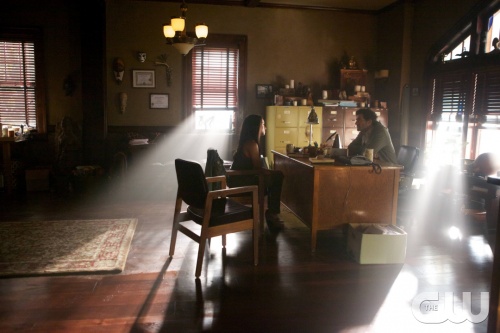
In this clip from television drama 'The Fear' it can be seen from the setting (which is shown through an extreme wide shot) that there is a clear class divide due to the fact it is a upper class practitioners surgery. Also stereotypically the audience can speculate that it is a private surgery due to its location being in a secluded area. Furthermore, when we as the viewer are shown the interior of the surgery you can get the impression that it is perhaps a cosmetic surgery by the images displayed around the room. In addition, you could get the impression that the people who work there are expected to represent the ideal men and women of our society. We can also see that the light in the surgery is completely made up of natural light so it can be seen that the show is set in the daytime. This can be seen as a basic assumption which can allow the viewer to base their other interpretations around. On the whole, you could say that the people who attend there are wealthy people who feels as if they have money to waste on unnecessary cosmetic surgery.
When the receptionist and patient are revealed the director has decided to use a tracking shot to subtly introduce the characters and to display the setting gradually to build tension and suspicion to keep the audience guessing. Furthermore, the use of mid close ups allow us to see the characters expressions to enable us to understand how they are feeling at that moment. Moreover, with the receptionist clothing you can get the impression that she is a smart, sophisticated, refined woman who can be seen in that hierarchy of work that she has less power perhaps compared to her boss. When her boss enters the room displayed through a wide shot and he can be seen that the pace of clip starts off slow however begins to pick up here. Perhaps the slowness at the beginning could portray that he may not want to actually be there and shows that doctors surgery can be associated with patients waiting a long time to see the doctor and shows that they normally get bored and feel that time is dragging on. to have the power of her due to several reasons. One being gender because men are expected to have the upper hand. Another interpretation would be his role in the workplace and that him being a plastic surgeon so in that hierarchy he is in charge of her and insures that she is working hard and stays focused on her work. Also he is presented as intelligent, respectable and wealthy and is reflected through his choice of costume for instance his suit. For most, in comparison the patients clothing is much more casual and a lot less refined looking as well. This then links in with him becoming less powerful when the doctor enters in.
Additionally, it can be said that the patient has power of the receptionist and this is reinforced by the dialogue that the receptionist and him exchange with one another. For example, the foul language used which shows that he has poor mannerisms and is very impolite and unaware of the concepts of other people's feelings. Also the way he is perceived to be positioned over her and this is conveyed through the chosen shot type tilt down. Furthermore, when he is raising his voice and holding the keyboard in his hand he can be seen as threatening and aggressive. In addition, the use of the diegetic sound he makes through banging it back on the desk conveys his anger and supports that he is mentally disturbed. However, she attempts to gain power through addressing him and explaining that he is in the wrong however this gets her belittled through his malicious temperament he maintains. With his personality you could say it resembles a version of Jekyll and Hyde meaning he has a split personality and can go from normal to abusive and violent in a split second. When it comes to the patient perhaps he has a mental disability and this is supported through the use of him lying on what seems to resemble a psychologists couch. Additionally, when he randomly plays the diegetic music which originates from the 1960s the subculture of cutting edge melodic rock and begins to reminisce on past memories, it shows to the audience that his thought track perhaps is a bit all over the place (has become muddled) and allows the audience to question why he is actually there.
In conclusion, it could seem that the receptionist and doctors lives are very distant from the patients. For most, this shows that class is the main representation and this is reflected in several ways to show that societies expectations and the hierarchy set out in life which plays a massive part in these characters lives.
Tuesday, 11 December 2012

Tuesday, 4 December 2012


Thursday, 22 November 2012
Discuss the ways in which the extract uses camera shots, mise en scene, sound and editing to construct representations of different generations
With this drama 'Some Girls' it can be seen as the female version of The Inbetweeners and is a comedy high school based drama. Especially in the theme segment the producers have decided to portray the girls as girly, typical teenagers whose lives are baed around them attending school, hanging out together etc. Furthermore, it can be seen that they are energetic which is shown through fast cutting of scenes and the montage following a fast pace. For most the fast pace may speculate that they are active and convey excitement to one another. Also they might be seen as trouble and that they all have their own individual personalities. In addition they can be seen that when getting ready for school they make a lot of effort and that they are healthy and motivated. Moreover, they can be seen to come from an urban background however they don't seem to come from families which are in financial struggle. With the different generations in this clip it can seem that they are represented through the use of various different techniques. For instance, it can seem that their traditional roles have been reversed this is reflected through the dialogue and the characters actions such as when the daughter is at home she can be seen to be independent and this conveyed by her fetching her own food whilst her father is in the middle of playing a video game instead of acknowledging her this can be shown to show that he is ignorant, self absorbed and immature. This is seen to be a contrast to a typical who would do the best for their child. For most, men are usually demonstrated to be hard working, busy and constantly active whereas he is lazy and does not want to help. Him playing video games could further convey his childlike immature attributes and how he should be more mature compared to his daughter. When they are having this conversation it can be noticed that the director has chosen to do a wide shot of the room to convey their living conditions and it is as normal as in any other household additionally the zoom ip on the father to shoe what he is doing instead of paying attention to her instead. You could say the roles are reversed and she is like a typical woman expected to care for the man but her age signifies that her parents should be the ones caring for her instead of her caring for them. With her stepmom in particular she is reflected to be a working woman however, she subverts the typical diligent, doting and loving housewife. She can also be seen as immature by acting bitchy and nasty like a typical teenage girl bitching about one of her friends. Furthermore, she can be seen as manipulative and headstrong and again shows a role reversals instead this time it is between her and her future husband. She also can be seen as not a fitting person for the role of a stepmother and could reflect the stereotypical evil stepmother like in Cinderella and could show that her morals are very traditional and old fashioned. When conflict is occurring the daughter seems to make sure her voice is heard however she is belittled and the roles are reversed back to the traditional ones. Also it can be seen that the teacher is the dominant and powerful participant in the scene and this is reflected through her tone of voice but furthermore, her gestures and sarcasm. It could be interpreted that their is a divide between her and her family and this is represented through their positioning and distance between them. Perchance it could signify that their relationship is complex and that there are unknown circumstances as into why the father has married a new woman and even though the step mother and daughters relationship has a strain involved due being her teacher however perhaps there is more to it than what meets the eye. The friendship which she has with the other girls shows that when times get rough she has people to turn to for moral support and to allow her to express her emotions, thoughts and feelings effectively. Especially, for example when she finds out that her dad and her step mum are having a child together. She passes judgement through expressing that she feels that they are not ready to have a child together and can be seen through how the dad cannot be responsible enough to take care of the kids he already has let alone a new born baby and the typical problems which follow on from that. Also we can see rather than him being the provider the girlfriend is so when she goes on pregnancy leave then the family perhaps will begin to fall apart even further. Another stereotype is teenagers and particularly with her brother he is portrayed to be immature, typical teenager engrossed in his phone and oblivious to his surroundings. Also she perhaps links to this stereotype when she storms out of house and slams the rotor and makes a massive thud this shows her anger towards her family and life and how it is getting to much for her to cope with. Other noises to express her anger and emotions would be her sighing and the sound of her throwing things round her room and then hitting other objects. With camera shots here they vary from following the objects with the use of a tracking technique furthermore a mid close up to show her anger and fury of the situation. Also prior to this when the argument was occurring the cutaways to the brother to convey his neutral and I'm not bothered attitude. Also through this Viva (the daughter) is displayed as a protagonist and not as stereotypical as her brother on the whole. In conclusion, it can seem that the different generations can be portrayed to be similar or counteract the conventions expected for their roles in society. For most, this is expressed with the help of several techniques which the audience can pick up on to understand how they vary and relate to real life situations and how much of it is over exaggerated.
Sunday, 11 November 2012
How are relationships represented in this clip
In the clip from the show 'Cutting it' the uses several different ways to show the ways in which relationships are represented throughout. For example, you could start off by analysing how close they are with one each other. From the extract this is represented through the use of props such as ring which signifies that the couple are married and the zoom up on the ring links in with the back story of how they got there. Furthermore, this can also be shown through him kissing her hand and giving each other doting looks and the way they are the majority of the time holding hands. In addition, it can be said that their relationship is also complex and this is represented through showing an uncertain present and future. Perhaps, when they are both playing with their rings that they are maybe thinking whether or not they have made the correct choice to get married or is it going to affect their relationship even more. It can displayed through their dialogue that they have each cheated on one another and that this is their second time being married to one another. It can also be shown that even though after everything she wants the best for him and if anything ever happened to her then she would want him to move on and find someone else maybe this is giving us as the audience a clue to what might happen to her and can be seen as dramatic irony. When analysing the clip it can be seen that both characters are very secretive and this is shown clearly through the inter cutting between the two characters when she is in the room with the consultant and he is outside whilst waiting for her also another indication of this would be how in the consultant room the dialogue is silenced out and is replaced by ambient which begins off sounding quite depressing then becomes much more cheerful as she exists the hospital maybe the producer wanted to create suspense. Furthermore, throughout the clip the are several examples of diegetic and non-diegetic sounds to allow it seem that the show is made from a low budget but also the sounds are varied depending on the scene and whether some may need to be emphasised to be able to noticed and due to significance it has within the scene. Examples of non-diegetic sounds used would be the heartbeat, music score and examples of diegetic sounds would be car engine and taxi door being shut. Especially, towards the end of the clip she says in a happy voice you never guess what this is a contrast to the music used in the consultant room it could be questioned is she telling her husband the truth or is she lying? All of this is left to the audience to make their own assumptions and to come to their own conclusions. In addition when she eventually gets hit by the bus people can seem the see the scene as over the top and exaggerated. Also, her husbands urgency to run to her when she is dying shows his love for her and it being on slow motion shows how is world is being turned upside down which is conveyed through his facial expressions and linking it to mise-en-scene and positioning of the characters in the frame where she is lying on the floor surrounded by lilies which usually signifies death and tragedy and the birds eye view of him and her lying on the floor links with his world crashing down on him and inevitably the audience could question what was she about to tell him and will we ever know or will it be kept as a mystery and a secret. In conclusion, to sum up the are several representations which show off their relationship and the several factors which construct and clear and understanding of how their relationship is complex, secretive and close to show its significance to the audience.
Thursday, 8 November 2012
Soap Opera Homework
At the moment I had trouble uploading photocopies of my work so at the moment I have had to upload pictures of them instead and will upload photocopies ASAP of my work! 


Ideas for own television series
Plot: A typical vampire love story but in traditional old fashioned England (Victorian times) it starts off in and then goes back and forward in time to the present day. She is a typical high school girl who has just started at a new school and is beginning to make new friends and then comes across a hot 16 year old boy who is broody and hot. Furthermore, she attempts to get to know him but after several hints about his true self she becomes freaked out and attempts to ignore him however there is something about him which lures her in. Characters: Hot vampire boy: George Shelley Young girl: Ella Henderson Best friend: Josh Cuthbert (friend of the vampire and is a vampire himself) Setting: Small English town and high school and each of their houses
Examples of different shot types used in tv drama
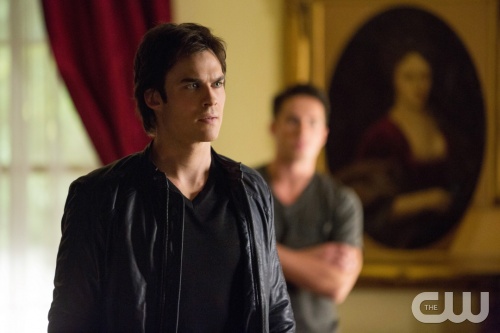
In this shot they have decided to blur out Tyler in the background and make Damon the main focus and his expression on his face shows that he is determined to do something about the situation with Elena struggling with being a new Vampire and coping with her thirst for human blood. Furthermore, it can be seen as a two shot and shows that out of the pair of them that Damon has the power and authority.
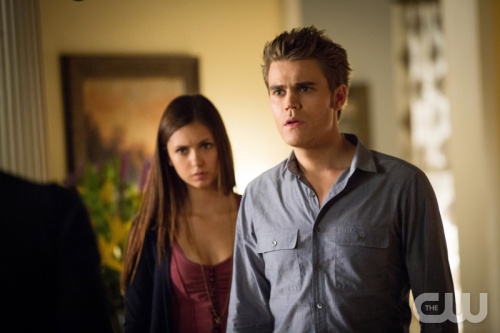
In this scene Stefan looks unsure and with it being a two shot it shows that the problem includes Elena and him. The positioning of the characters show that at this point Elena is vunerable and all Stefan wants to do is to protect her.
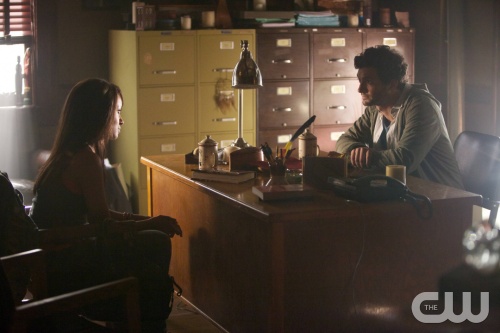
In this scene the dark lighting shows an element of mystery and with it being shot from a side angle allows the viewer to focus on where they are and that this conversation needs to be kept between them only. Also the slight element of natural light show to the audience and that the conversation is taking place in the daytime.
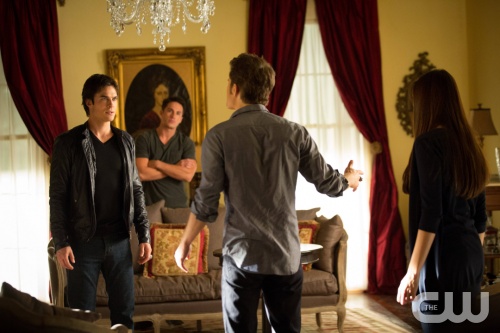
In this scene it can be seen as a wide shot/ over the shoulder and also it builds tension. With Stefans hand gestures it shows that he is very protective of Elena and shows that the dicussion is about her transition from a humn to a vampire.
This is a wide shot and shows that the two of them are completely alone and gain that the conversation is only between them.

In this scene it is a over the shoulder shot which builds tension and with the Grandmother's angry expression shows how furious she is with her Grand daughter.

In this scene it is a two shot and you can tell that they have a very casual amd happy bond with one another. It shows that the two characters are very laid back and relaxed.

In this the audience can gather a sense of urgency from Lorelai and that she is speaking to Luke really quickly and she is determined to know whether their relationship is anything and

It can be seen that there is distance between them which could signal that they have had an arguement and still has not been fully resolved. Also it can be seen through their hand and arm gestures for example Rory crossing her arms shows that she is angry but deep down she still loves her mum.
Friday, 26 October 2012
Key Terms Glossary
Sound
Digetic sound: can be either on screen or off screen depending on whatever its source is within the frame or outside the frame.Non-diegetic sound: is represented as coming from the a source outside story space.
Soundtrack:
1. The narrow strip at one side of a movie film that carries the sound recording.
2.
a. The music that accompanies a movie.
b. A commercial recording of such music
Theme:
Tune: A sound; a note; a tone.
1. A topic of discourse or discussion.
2. A subject of artistic representation.
3. Music The principal melodic phrase in a composition, especially a melody forming the basis of a clip.
Tune: A sound; a note; a tone.
Incidental music: is often "background" music, and adds atmosphere to the action. It may take the form of something as simple as a low, ominous tone suggesting an impending startling event or to enhance the depiction of a story-advancing sequence.
Sound effects (or audio effects): are artificially created or enhanced sounds, or sound processes used to emphasise artistic or other content of films, television shows, live performance, animation, video games, music, or other media.
Ambient sound: or ambient audio means the background sounds which are present in a scene or location. Common ambient sounds include wind, water, birds, crowds, office noises, traffic, etc.
Dialogue: (sometimes spelled dialog in American English) is a literary and theatrical form consisting of a written or spoken conversational exchange between two or more ("dia" means through or across) people.
Voice over: (also known as off-camera or off-stage commentary) is a production technique where a voice that is not part of the narrative (non-diegetic) is used in a radio, television production, filmmaking, theatre, or other presentations.
CAMERA SHOTS
Aerial Shot – A camera shot taken from an overhead position. Often used as an establishing shot.
Close Up – A head and shoulders shot often used to show expressions/emotions of a character. Also can be a shot of an object, filmed from close to the object or zoomed in to it, that reveals detail.
Extreme Close Up – A shot where a part of a face or body of a character fills the whole frame/dominates the frame. Also can be a shot of an object where only a small part of it dominates the frame.
Establishing Shot – A shot that establishes a scene, often giving ther viewer information about where the scene is set. Can be a close up shot (of a sign etc) but is often a wide/long shot and usually appears at the beginning of a scene.
Medium Shot – the framing of a subject from waist up.
Two Shot – A shot of two characters, possible engaging in conversation. Usually to signify/establish some sort of relationship
Point-Of-View Shot (POV) – Shows a view from the subject’s perspective. This shot is usually edited so that the viewer is aware who’s point of view it is.
Over the Shoulder Shot – looking from behind a character’s shoulder, at a subject. The character facing the subject usually occupies 1/3 of the frame but it depends on what meaning the director wants to create (for example, if the subject is an inferior character, the character facing them may take up more of the frame to emphaise this)
Overhead Shot – a type of camera shot in which the camera is positioned above the character, action or object being filmed.
Reaction Shot – a shot that shows the reaction of a character either to another character or an event within the sequence.
CAMERA ANGLES
Camera Angle – the position of the camera in relation to the subject of a shot. The camera might be at a high angle, a low angle or at eye level with what is being filmed.
High Angle – A camera angle that looks down upon a subject or object. Often used to make the subject or object appear small or vulnerable.
Low Angle – A camera angle that looks up at a subject or object. Often used to make the subject/object appear powerful/dominant.
Canted framing (or oblique) – camera angle that makes what is shot appear to be skewed or tilted.
CAMERA MOVEMENT
Pan – Where the camera pivots horizontally, either from right to left or left to right to reveal a set or setting. This can be used to give the viewer a panoramic view. Sometimes used to establish a scene.
Track - a shot whjere the camera follows a subject/object. The tracking shot can include smooth movements forward, backward, along the side of the subject, or on a curve but cannot include complex movement around a subject. ‘Track’ refers to rails in which a wheeled platform (which has the camera on it) sits on in order to carry out smooth movement.
Crane – A crane shot is sometimes used to signify the end of a scene/ programme /film. The effect is achieved by the camera being put onto a crane that can move upward.
Stedicam - A steadicam is a stabilising mount for a camera which mechanically isolates the operator's movement from the camera, allowing a very smooth shot even when the operator is moving quickly over an uneven surface. Informally, the word may also be used to refer to the combination of the mount and camera.
Tilt - where a camera scans a set or setting vertically (otherwise similar to a pan).
Zoom – Using a zoom lens to appear to be moving closer to (zoom in) or further away from (zoom out) a subject/object when in fact the camera may not move (so, strictly not camera movement). Can be used for dramatic effect.
EDITING
Editing – the stage in the film-making process in which sound and images are organised into an overall narrative.
Continuity Editing – the most common type of editing, which aims to create a sense of reality and time moving forward. Also nick named invisible editing referring to how the technique does not draw attention to the editing process.
Jump Cut – An abrupt, disorientating transitional device in the middle of a continuos shot in which the action is noticeably advanced in time and/or cut between two similar shots, usually done to create discontinuity for artistic effect.
Credits – the information at the beginning and end of a film, which gives details of cast and crew etc.
Cross Cutting – the editing technique of alternating, interweaving, or interspersing one narrative action (scene, sequence or event) with another – usually in different locations or places, thus combining the two: this editing technique usually suggests Parallel action (that takes place simultaneously). Often used to dramatically build tension and/or suspense in chase scenes or to compare two different scenes. Also known as inter-cutting or parallel editing
Cutaways – A brief shot that momentarily interrupts continuous action by briefly inserting another related action. Object, or person (sometimes not part of the principle scene or main action), followed by a cutback to the original shot.
Freeze Frame – the effect of seemingly stopping a film in order to focus in on one event or element.
Eye-line Match – a type of edit which cuts from one character to what that character has been looking at.
Flashback – a scene or moment in a film in which the audience is shown an event that happened earlier in the film’s narrative.
Graphic Match – an edit effect in which two different objects of the same shape are dissolved from one into the other.
Juxtaposition – the placement of two (often opposed) images on either side of an edit to create an effect.
Linear Narrative – a style of storytelling in which events happen chronologically.
Montage Editing – the juxtaposition of seemingly unconnected images in order to create meaning.
Parallel Editing – a type of editing in which events in two locations are cut together, in order to imply a connection between the two sets of events.
Visual Effects - visual effects are usually used to alter previously-filmed elements by adding, removing or enhancing objects within the scene.
Match on Action - A shot that emphasises continuity of space and time by matching the action of the preceding shot with the continuation of the action. (For example a shot of a door opening after a shot of a close up of a character’s hand turning a door handle)
Sourced from: http://longroadtvdrama.blogspot.co.uk/2009/05/tv-technical-terms-glossary.html
Sunday, 14 October 2012
Roles and Jobs in a TV Drama
Drama Production Team
Those in the production roles are responsible for setting up and shooting every scene in the drama. Some of the people involved are listed below.
Producer
The producer, whether working in radio, TV or online, oversees the entire production and brings together all the different elements and people. The role also requires him or her to be across all the various stages of production.
Director
The director’s role is to take overall responsibility for the creative, visual and sound aspects of a production. Often there are first and second assistant directors, who are involved in preparing the filming schedule and ensuring everyone sticks to it. They also work to make sure the director has everything he or she needs to achieve the look and feel required.
Production Manager
Overseeing a production from start to finish, a production manager keeps a tight reign on the budget and organises all support facilities, including accommodation, catering and transport. He/she will also plan crews, equipment and facilities.

Script Editor
The script editor works between the writer and the producer to make sure the story crosses from paper to the small screen effectively. He/she will ensure scripts are ready on time and help create the atmosphere the script is trying to get across.
Script Continuity
To ensure each scene continues on from the previous one smoothly it is up to those working in script continuity to keep on top of the filming. Maintaining scenery, wardrobe, lighting is all essential so that the final edit can be made accurately and seamlessly.
Production secretary
You’ll provide essential administrative support to the production team by fulfilling a wide variety of traditional secretarial duties.

Location Manager
Responsible for finding locations and ensuring a hassle free filming session are the two principal roles of a location manager. He/she is also responsible for health and safety and dealing with owners and those who usually use the chosen location.
Researcher
Supporting the producer, you'll contribute ideas, contacts and sources, as well as interviewing possible contributors and writing briefings and reports. Although some areas require specialist knowledge, this can be an entry level role if you've got some appropriate experience.
RunnerAlthough you'd be the most junior member of the production team, you'll have the chance to get involved in all aspects of production, from photocopying to helping out with research. This is how a lot of people get their first break in the industry, as it's a common entry-level role.
Sourced from: http://www.bbc.co.uk/newtalent/drama/advice_production.shtml
Representations of Social Groups
When researching this I came across a really useful powerpoint on slideshare so here is the link and it explains how gender is represented and several other social groups within society:
http://www.slideshare.net/graveneymedia/g322-common-representations-of-specific-social-groups
http://www.slideshare.net/graveneymedia/g322-common-representations-of-specific-social-groups
Friday, 28 September 2012
How are social groups represented in music videos?
For this task I have chosen to analyse all three versions of the Band Aid videos with the song 'Do they know its Christmas Time'.
In the first video made in 1984 (the original) it begins with a medium close up of a copy of a newspaper with an article stating Band Aid and using a picture of the participants who are involved vocally this can demonstrate that within the music world that several care about the world around them and not just themselves. Then progressively it be seen that there are several different shots to show each other the participants involved, for example, there is a usage of noddy shots to show all the equipment involved in making and producing the song and video. In addition, there is a usage of point of view shots towards the begining to portray to the audience where this production is intially taking place, then furthermore, throughout there is a constant use of close ups of the participants, cutaway shots of the crew who are putting in a lot of effort to achieve their desired outcome, also there is a mixture of wide and very wide shots to show the artists arriving and certainly when they are all performing together as on group this could be done to represent the rest of the world coming together to help.
Moreover, within this video there are several meanings to as in why these particpants are doing this song and that there several under wrapped deeper meanings to the video as well. For example, even though that the most popular music acts are coming together to attempt to save all of the people in Africa from stravation, and even poverty and aids etc. However, if you was to talk about race and the majority of one ethnic group it can be seen that that majority are richer and the Africans are seen to be less fortunate that it seems to be a issue of the rich helping the poor and in away can be seen as undermiming them. This can be seen as unethical but due to the low economy over there and the growing population that the wealthy people are constsantly trying to fix these issues, which sadly I feel will be even more impossible to fix due to the population being to dense.
However, considering how it was portrayed in 1984 the 1989 version shows several clips of the situation to build and create a situation which will enable there audience to sympathise to the on going problems in Africa. At the start of this version it starts off with a reporter in Africa explaining the situation and moving the camera through the crowds of them, this can show that because of the ongoing population that problems are getting worse and action needs to take hold. Same as the original all the camera angles are near enough the same and showing that all of the artists taking part passionately care. But now compared to the original the minority ethnic group participants have increased so it demonstrates how far society has progressed since 5 years ago.
Finally, in the more recent version shot in 2004 it can be noticed that there is now an equal amount of participants of each ethnic background shows that respect of other backgrounds and cultures have becoming a conserable lot more acceptable and that equal rights such wealth are equal between these groups in society as well. Also to end that again all the shots taken are made up of similar camera angles with similar representations.
In conclusion the social groups here being talked about has allowede black people have become more respected within society and are now equal to white people.
In the first video made in 1984 (the original) it begins with a medium close up of a copy of a newspaper with an article stating Band Aid and using a picture of the participants who are involved vocally this can demonstrate that within the music world that several care about the world around them and not just themselves. Then progressively it be seen that there are several different shots to show each other the participants involved, for example, there is a usage of noddy shots to show all the equipment involved in making and producing the song and video. In addition, there is a usage of point of view shots towards the begining to portray to the audience where this production is intially taking place, then furthermore, throughout there is a constant use of close ups of the participants, cutaway shots of the crew who are putting in a lot of effort to achieve their desired outcome, also there is a mixture of wide and very wide shots to show the artists arriving and certainly when they are all performing together as on group this could be done to represent the rest of the world coming together to help.
Moreover, within this video there are several meanings to as in why these particpants are doing this song and that there several under wrapped deeper meanings to the video as well. For example, even though that the most popular music acts are coming together to attempt to save all of the people in Africa from stravation, and even poverty and aids etc. However, if you was to talk about race and the majority of one ethnic group it can be seen that that majority are richer and the Africans are seen to be less fortunate that it seems to be a issue of the rich helping the poor and in away can be seen as undermiming them. This can be seen as unethical but due to the low economy over there and the growing population that the wealthy people are constsantly trying to fix these issues, which sadly I feel will be even more impossible to fix due to the population being to dense.
However, considering how it was portrayed in 1984 the 1989 version shows several clips of the situation to build and create a situation which will enable there audience to sympathise to the on going problems in Africa. At the start of this version it starts off with a reporter in Africa explaining the situation and moving the camera through the crowds of them, this can show that because of the ongoing population that problems are getting worse and action needs to take hold. Same as the original all the camera angles are near enough the same and showing that all of the artists taking part passionately care. But now compared to the original the minority ethnic group participants have increased so it demonstrates how far society has progressed since 5 years ago.
Finally, in the more recent version shot in 2004 it can be noticed that there is now an equal amount of participants of each ethnic background shows that respect of other backgrounds and cultures have becoming a conserable lot more acceptable and that equal rights such wealth are equal between these groups in society as well. Also to end that again all the shots taken are made up of similar camera angles with similar representations.
In conclusion the social groups here being talked about has allowede black people have become more respected within society and are now equal to white people.
Thursday, 27 September 2012
TV Scheduling
Here is my research on television scheduling:
Television scheduling is part art, part science. The art comes from predicting which programmes viewers might watch together in blocks, going from one show to another on the same channel on the same night. The science comes from analysing ratings and demographics in order to discover who is watching a particular show, and how/when.Before the video recorder, watching a TV show was a shared social experience. Whole nations would all "tune in at the same time" to watch a popular show, especially if there was some kind of cliffhanger set up or resolution, or for the finale of a drama. In a small country like the UK, where all viewing happens in the same time zone, this causes a phenomenon known as TV Pickup, a surge in the National Grid that occurs immediately before and after a record-rated show, as everyone switches on their kettles or other small appliances after walking away from their TV. In the age of time-shifted viewing, it's very rare to see the kind of power surge that occurred after the 1984 broadcast of The Thorn Birds finale (the biggest surge experienced after a TV drama), but surges still happen, after big events like major football matches or a royal wedding.
If people watch the same TV show at the same time, then that's what everyone wants to talk about the next day at school or work. In the days before time-shifted TV, episodes of shows became hot topics the following morning 'around the water cooler', discussed simultaneously in newspaper reviews and ordinary conversation. "Water Cooler TV" is still a phrase bandied round by TV executives, but it's now used to describe the global discussion that goes on about TV shows via social media networks like Twitter and Facebook, as well as via blog posts.
Social media is useful to TV networks for generating excitement prior to the broadcast of a show, and for ensuring that as many people as possible tune in during the original time slot. The creation of Facebook pages and Twitter feeds for shows and characters is a vital tool for building fan loyalty. This is particularly important for the finale of a talent show like American Idol or BGT. Because so many people discuss the content of a show via tweets and status updates as it happens, spoilers abound on the internet for anyone who's not next to a TV set.
However, social media is a double-edged sword where international drama sales are concerned. When viewers in one country get to see a show first, their online discussion may spoil things for viewers in other countries, especially where the death of a character or a plot twist is concerned. Networks are well aware of this problem, because it generates demand for pirated shows. Unable to wait, a fan might illegally download episodes of their favorite show so that they can keep up with the online chatter - and know what happens! Dexter was the most downloaded TV show of 2011, because Season Six was broadcast in the US long before it appeared anywhere else.
Scheduling strategies
Block programming
Block programming occurs when the television network schedules similar programs back-to-back. The concept is to provide similar programming to retain viewership.Crossprogramming
Crossprogramming involves the interconnection of two shows. This is achieved by dragging a storyline over two episodes of two different programs.
Bridging
Bridging is being used when a station tries to prevent the audience from changing channels during a junction point - the main evening breaks where all channels stop programs and shift gear (Ellis, 2000). This is achieved in a number of ways including: having a program already underway and something compelling happening at a junction point, running a program late so that people ‘hang around’ and miss the start of other programs, or television advertising the next program during the credits of the previous.
Counterprogramming
Counterprogramming is used when a time period is filled with a program whose appeal is different from the opponent program because it is a different genre or appeals to a different demographic.Dayparting
Dayparting is the practice of dividing the day into several parts, during each of which a different type of radio programming or television programming appropriate for that time is aired. Daytime television programs are most often geared toward a particular demographic, and what the target audience typically engages in at that time.
- Sign-on
- Early morning news
- Early morning
- Late morning
- Daytime television
- Early fringe
- Lunchtime news
- Early afternoon
- Late afternoon
- Early evening
- Evening news
- Prime time
- Late-night news
- Late night television
- Graveyard slot
- Sign-off (closedown)
- Late fringe
- Post late-fringe
Hammocking
Hammocking is a technique used by broadcasters whereby an unpopular program is scheduled between two popular programs in the hope that viewers will watch it. Public television use this as a way of promoting serious but valuable content.
Hotswitching
In Hotswitching, the programmers eliminate any sort of commercial break when one program ends and another begins; this immediately hooks the audience into watching the next program without a chance to change the television channel between programs.
Stacking
Stacking is a technique used to develop audience flow by grouping together programs with similar appeals to "Sweep" the viewer along from one program to the next (Vane and Gross, 1994, p. 175).
Stripping
Stripping is running a syndicated television series every day of the week. It is commonly restricted to describing the airing of shows which were weekly in their first run; The West Wing could be stripped, but not Jeopardy! as the latter is already a daily show. Shows that are syndicated in this way generally have to have run for several seasons (the rule of thumb is usually 100 episodes) in order to have enough episodes to run without significant repeats.
Tentpoling
In tent pole programming the programmers bank on a well-known series having so much audience appeal that they can place two unknown series on either side, and it is the strength of the central program that will bring the others along to victory.
Theming
Having special theming days (such as for a holiday), or theme weeks such as Discovery Channel's Shark Week.
Scheduling strategies
A typical scheduling strategy used in Argentinian radio and television is called "pase" (Spanish for a "pass" as in a player passing the ball to another player of the same team). A few minutes before the end of a live broadcast show, followed by another live broadcast show, people from both programmes will share some air time together. This may be used for people from the starting programme to anticipate its contents of the day, or to participate in an ongoing discussion in the previous show, or simply for an entirely independent debate or chat that will not be furthered after the "pase". On the radio, where newscasts are usually broadcast every thirty minutes, often in coincidence with the end of a show, the "pase" may take some minutes before the news, and sometimes some minutes afterwards, too.Alternatively, if there is no "pase", light jokes or comments can be made in a show involving people of the following show, so that some viewers or listeners might be interested in hearing what the reply will be.
Also, when a station has a new show starting, or if it needs to boost its ratings, part of its cast will be featured in other programmes in the same station, inserted in the dynamics of the programme they are in. For example they will participate in game shows, be interviewed by the journalists of the station, make cameos in a series, substitute for the usual staff of other shows in their habitual functions, etc. Additionally, hosts of live programmes may mention repeatedly the new show and its time slot, trying to encourage their own viewers to watch it.
Sunday, 23 September 2012
Why do audiences enjoy watching crime dramas?
It is known that several people love to watch crime dramas but behind the basic reason why they watch it for example, for enteratinment there must be several other contributing factors, so below I will explain several other key elements why they do.
Television crime dramas can be seen as having a engaging narrative which offers a space for debates about policing, criminality, gender, race and social and cultural values, this then engages the audience to allow them to want to watch the next episode to find out what will happen, also the subjects brought up in these drama may even be relatable or interesting enough for us to want to find out more about them. There are several key elements to crime dramas such as, they all have a resolution to a mystery, question of morality, debates about the innocent and guilty, verisimilitude meaning there are several representations of ordinary people in everyday environments, cliffhangers, suspense, enigma, typical dramatic irony to perhaps make the audience laugh to relate back to its purpose to entertain and set pieces and conflict. Refering back to the point about enigma for this you could say how information is distributed to the audience for example the creators want to keep you on your toes and to give the impression that the characters are in mystery. Furthermore, there is power struggles between divisions of the police, government and the police and the judiciary system and the police, possibly conflicts could also occur between these divisions as well. Additionally TV dramas in general can sometimes been seem as escapism (companionship) for example the elederly who have very little to look forward to in life and feel as if they are getting involved with the show and can sometimes allow some people more to talk about and can also be seen as a comfort as well.
Furthermore, it seems that over the years stereotypes in crime dramas have become more modernised in their views and actions, for example the traditional police and inspector has changed in the way they are presented to the audience as well percieved by the audience. For example, in 'Inspector George Gently' he can be seen as typical old fashioned inspector with a stereotypical mac wrapped over the arm and the police team in this drama seem quite laidback compared to in 'Good Cop ' they are seen to always be on their toes because crime has got worse now compared to about 20 years back. Moreover, crime dramas can provide the audience knowledge of the world around them that they are unaware of and also there is a element of personal identity when they try to compare themselves perhaps to the characters and attempt to perhaps feel some empathy for them as well for example in 'The Accused' you could say that perchance the audience can empathise for the wrong personal due to feeling that deep down that they would want the character to get a way with the crime instead of getting found out'. Linking it to the use of the gratification theory because of it we use dramas to conceivably please ourselves and to allow us to feel some gratitude. Within this theory there are for different categories known as Information (Insightful), Diversion (Involvement), Identity(Comparisons) and Companionship (Getting to know), which can link to several reasons I have stated above in the earlier part of my essay.
So on the whole there are several factors which contribute to why people choose to watch crime dramas day in and day out and how there perception of certain types of characters involved in them have changed.
Television crime dramas can be seen as having a engaging narrative which offers a space for debates about policing, criminality, gender, race and social and cultural values, this then engages the audience to allow them to want to watch the next episode to find out what will happen, also the subjects brought up in these drama may even be relatable or interesting enough for us to want to find out more about them. There are several key elements to crime dramas such as, they all have a resolution to a mystery, question of morality, debates about the innocent and guilty, verisimilitude meaning there are several representations of ordinary people in everyday environments, cliffhangers, suspense, enigma, typical dramatic irony to perhaps make the audience laugh to relate back to its purpose to entertain and set pieces and conflict. Refering back to the point about enigma for this you could say how information is distributed to the audience for example the creators want to keep you on your toes and to give the impression that the characters are in mystery. Furthermore, there is power struggles between divisions of the police, government and the police and the judiciary system and the police, possibly conflicts could also occur between these divisions as well. Additionally TV dramas in general can sometimes been seem as escapism (companionship) for example the elederly who have very little to look forward to in life and feel as if they are getting involved with the show and can sometimes allow some people more to talk about and can also be seen as a comfort as well.
Furthermore, it seems that over the years stereotypes in crime dramas have become more modernised in their views and actions, for example the traditional police and inspector has changed in the way they are presented to the audience as well percieved by the audience. For example, in 'Inspector George Gently' he can be seen as typical old fashioned inspector with a stereotypical mac wrapped over the arm and the police team in this drama seem quite laidback compared to in 'Good Cop ' they are seen to always be on their toes because crime has got worse now compared to about 20 years back. Moreover, crime dramas can provide the audience knowledge of the world around them that they are unaware of and also there is a element of personal identity when they try to compare themselves perhaps to the characters and attempt to perhaps feel some empathy for them as well for example in 'The Accused' you could say that perchance the audience can empathise for the wrong personal due to feeling that deep down that they would want the character to get a way with the crime instead of getting found out'. Linking it to the use of the gratification theory because of it we use dramas to conceivably please ourselves and to allow us to feel some gratitude. Within this theory there are for different categories known as Information (Insightful), Diversion (Involvement), Identity(Comparisons) and Companionship (Getting to know), which can link to several reasons I have stated above in the earlier part of my essay.
So on the whole there are several factors which contribute to why people choose to watch crime dramas day in and day out and how there perception of certain types of characters involved in them have changed.
Thursday, 20 September 2012
Shot types
* EWS (Extreme Wide Shot)
The view is so far from the subject that he isn't even visible. Often used as an establishing shot.* VWS (Very Wide Shot)
The subject is visible (barely), but the emphasis is still on placing him in is environment.* WS (Wide Shot)
The subject takes up the full frame, or at least as much as comfortably possible. AKA: long shot, full shot.* MS (Mid Shot)
Shows some part of the subject in more detail while still giving an impression of the whole subject.* MCU (Medium Close Up)
Half way between a MS and a CU.* CU (Close Up)
A certain feature or part of the subject takes up the whole frame.* ECU (Extreme Close Up)
The ECU gets right in and shows extreme detail. Variation: Choker* Cut-In
Shows some (other) part of the subject in detail.* CA (Cutaway)
A shot of something other than the subject.* Two shot
A shot of two people, framed similarly to a mid shot.* (OSS) Over-the-Shoulder Shot
Looking from behind a person at the subject.* Noddy Shot
Usually refers to a shot of the interviewer listening and reacting to the subject.* Point-of-View Shot (POV)
Shows a view from the subject's perspective.* Weather Shot
The subject is the weather. Can be used for other purposes, e.g. background for graphics.Conventions
* Well constructed plot
* Relatable aspects
* Exaggeration
* Relatable aspects
* Exaggeration
Denotation- a literal meaning
Connotation- hiding meaning assosiations, emotional and otherwise
Ideas for further reading
* Douglas Kellner- 'Television Images, Codes and Messages'
"a genre refers to a coded set of formulas and conventions which indicate a culturally accepted way of organising material into distinct patterns. Once established, genres dictate the basic conditions of cultural production and reception."* Martin Esslin 'The age of television'
* Bardwell & Thomson's 'Film Art'
TV Drama Introduction Lesson 1
TV Drama
Here is a list of types of television drama's:
* Soap opera (Eastenders, Emmerdale, Coronation Street)
* Costume/ period drama (Downton Abbey, Miss Marple, The Tudors)
* Medical/ emergency (Casualty, Holby City, ER)
* Literary adaptations (Great Expectations, Little Dorrit, Emma)
* Crime drama (The Bill, Hustle, Minder)
* Contemporary Melodrama (Burke & Hare, Sweeny Todd, Lady Audley's Secret)
* Comedy drama (A touch of cloth, Beaver Falls, Doc Martin)
* Sci-fi/ fantasy (Dr. Who, The Vampire Diaries, Angel)
* Spy Drama (Spooks, Tinker Tailor Solider Spy, Smiley's People)
Conventions of TV Drama
What set of rules, codes or formulae does TV Drama follow?* Scripted, fictional narrative
* Central characters
* Often continuous story lines
* Key themes
* Verisimilitude (relatable, realistic settings, characters and story lines)
* Could be a one-off/ special, mini-series, serial
* Serials can be progressive story lines, continuing from week to week and developing across a series, or can be self-contained each episode, despite featuring the same characters and settings.
* Distinctive style of directing/ shooting
Wednesday, 19 September 2012
Introduction to exam work
Hi welcome to my media exam work, this blog will contain a variety of revision, homework tasks and extra research.
Within the exam I have to sit and the end of this year there is two parts to it, below is a copy of the syllabus for my exam work.
* Institutions and Audiences
The specific industry we have been told that we are studying is Film and at the moment in class we are studying about TV Drama's.
Within the exam I have to sit and the end of this year there is two parts to it, below is a copy of the syllabus for my exam work.
What the exam covers:
* Textual Analysis + Representation* Institutions and Audiences
Section A (50 marks)
Candidates answer questions on a unseen moving image extract and link to an aspect of representation written in the sequence.Section B (50 marks)
Candidates study a specific media industry from: film, music, newspapers, radio, magazines or video games.The specific industry we have been told that we are studying is Film and at the moment in class we are studying about TV Drama's.
Subscribe to:
Posts (Atom)